Showing posts with label Book Review. Show all posts

Sunday, April 17, 2016

In which I review "The Novel Habits of Happiness"

image credit: amazon

The title first caught my eye: The Novel Habits of Happiness. What are the new habits of happiness? I'd come to the conclusion that, for the most part, what makes us truly happy has stayed virtually the same: social connection, a feeling of being needed or of worth, being able to love and be loved in return. Sure and there are novel ways of achieving those things, I suppose. Also, I smiled, thinking that it could be a pun, and that the person's novel habits of happiness are indeed derived from novels, books. AND the book is by Alexander McCall Smith, whose modern adaptation of Emma I liked and reviewed here.

It was only 257 pages, it was shelved under "mystery," and it promised a series of reads if I enjoyed this book. So, thinking I had nothing to lose, I took the plunge. Yes, you might be saying, but what did you think of it??? This is, after all, a review. Well, touche, yes this is a review. And now that you know the why and wherefore, here are some thoughts I had on The Novel Habits of Happiness.

The book is set in Edinburgh, Scotland, and the heroine is an early 30s philosopher named Isabel Dalhousie. Throughout the novel, Isabel references philosophers and goes off onto philosophical questions and ideas throughout her day. I found this interesting, as sometimes I find myself thinking of the deeper morals and implications of things, and these thoughts could be set off by any number of things. If you're looking for a real mystery novel, this book is not for you. While shelved as mystery and called an amateur sleuth on the inside cover, Isabel is commissioned by a worried single mother to investigate her son's persistent claims that he had a past life. Delving into the paranormal, though she does not really believe it herself, Isabel investigates around the area of Scotland the young boy seemed to be referencing. I will not say what she found, or to what conclusions she came to with the mother.

I'll only say that I enjoyed visiting with Isabel, her husband Jamie, their little boy Charlie, and the numerous quirky characters that make up Isabel's life in Edinburgh. The pages given to Isabel's work on her philosophical magazine, The Review of Applied Ethics, were interesting and I did not mind that most of the story was about her life and characters, as opposed to more plot-driven drama and suspense.

If you're looking for a cozy read, with some interesting characters, and just a hint of mystery, give this book a try. By my reasoning, if you enjoy it, there's more in the series to check out (and I have and so far I am enjoying them as well.)

The only qualm I had, which not everyone will have, is that though Isabel was so generous and open-minded about so many things, and prided herself upon these facts, I found her to be close-minded and dismissive on the subject of religion. When God or Protestantism or anything hinting at a deity appears, Isabel seems to have the view that many have been "Enlightened" past that stage, where ethics and morals are the foundation themselves, and not a belief in a higher power being the cornerstone which leads to such morals and convictions. Now, I'm fine with a character being atheist, really, but it bothers me when they believe themselves to be "above religion" and to almost scoff or pity the folks who hold on to a sense of belief, likening it to the tooth fairy (I can't remember which of the Isabel novels I saw that idea in, but it was there!) On all other points though I found Isabel to be kind and intelligent, dealing in mysteries only to help others caught in them.

So while this isn't a fully comprehensive review, it has bobs of this and that and gives the feel and idea of the book and series, I hope. Those are my thoughts, and I'd love to hear yours. Have you read any Isabel Dalhousie novels? Does anyone else find philosophy and morals as interesting as I do? (I'm sure some do!) What mysteries do you love to read?

Monday, January 18, 2016

In which I reflect on Gilead


I was gifted Gilead by Marilynne Robinson for Christmas this year. I had asked for it because a beloved blogger, Sarah Bessey, refers to and seems to love her novels, especially Gilead. I had read Lila in the fall, and after I got used to Robinson's unusual writing style, I really enjoyed the read. These books can't be read quickly- or shouldn't be, at least. Robinson is more thought based, inward seeking, than is normal for books.

Event and action driven plot really isn't the idea here. Here are characters to learn about, thoughts to ponder, the grace of everyday things to wonder at.

To state the bare bones of the novel, Gilead is about "a story about fathers and sons and the spiritual battles that still rage in America's heart. In the luminous and unforgettable voice of Congregationalist minister John Ames, Gilead reveals the human condition and 'manages to convey the miracle of existence itself.'"

All that is true... but I found more. And less. All at the same time.Yes there is "spiritual battles" and "human condition" and fancy words and thoughts like that. But there is simple life in Iowa. There are jumbled, seemingly insignificant, but ordinary and therefore beautiful memories of the inward and quiet life of a person.

There is this wonder that was never lost, this unimaginable but perfectly human love and wonder of the world. There is doubt, and despair; that I found in the novel. And that I appreciated. It did not take away from the sincerity of Ames' beliefs. It did not make him seem hypocritical as a minister with doubts and uncertainty. It made him seem more real, more sincere. Because there were doubts and questions. We all have them, though we may be afraid to voice them, whether because that makes them real, gives them form and a voice or because of fear of what others would think of us when we admitted to them-what we would think of ourselves should such things be spoken aloud.

But Ames leans into the pain. He recognizes his doubts and despair and instead of defending them or arguing them away, he looks at them, he sees them, and he sits with them. He goes into the Wilderness and there he finds a feast, a table, laid for him, for the Lord is there in the doubts and wonderings and wanderings of His people.

And he is not all doubtful. This is not the "look, I was religious but now I have risen above that with my doubts and intellect. I am spiritual or atheist." And these stories have their place, of course, of course. Because that is a human experience. But there is another human experience and I don't believe that one has been "fleshed out" as much.

Ames has his doubts, fears, and despair. He has loneliness and aches, both physical and emotional. But. He has beliefs. He has a faith that is not blind, but that is strong. He has a foundation. He knows that God is beyond his or anyone else's full  capacity to know in this life, and maybe in the next, but he believes certain statutes that carry him through his life and ministry: He believes in one God, he believes in Jesus as his son and the resurrection. He thinks there is an inherent "being-ness" and fractured beauty in people. He believes in grace. So much grace. Beautiful, mysterious, common-place everyday grace. 

And this beautiful grace and peace is woven throughout the story. This accepting-ness and wonder at people, the world, and faith lies behind and between every sentence in this book.

...So I loved it, if you could not tell at this point. I thought it was funny, I thought it was ordinary, and in the "common uncommonness" of it all, I found a grace and beauty in myself and my own life. And for that I believe this will be a comfort book for me, not that every idea is comforting, but because I believe it has Truth and it has Beauty. And who does not wish for more of that in their life?

Quotes:

"I have wandered to the limits of my understanding any number of times, out into that desolation, that Horeb, that Kansas, and I've scared myself, too, a good many times, leaving all landmarks behind me, or so it seemed. And it has been among the true pleasures of my life.... Though I must say all this has given me a new glimpse of the ongoingness of the world We fly forgotten as a dream, certainly, leaving the forgetful world behind us to trample and mar and misplace everything we have ever cared for. That is just the way of it, and it is remarkable" (191)

"I have thought about that very often- how the times change, and the same words that carry a good many people into the howling wilderness in one generation are irksome or meaningless in the next" (176).

"In the matter of belief, I have always found that defenses have the same irrelevance about them as the criticisms they are meant to answer. I think the attempt to defend belief can unsettle it, in fact, because there is always an inadequacy in argument about ultimate things. We participate in Being without reminder" (178).

"My point here is that you never do know the actual nature of even your own experience. or perhaps it has no fixed and certain nature" (95).

"'Man is born to trouble as the sparks fly upward.' And really, it was that night as if the earth were smoldering. Sell, it was, and it is. An old fire will make a dark husk for itself and settle in on its core, as in the case of this planet. I believe the same metaphor may describe the human individual, as well. Perhaps Gilead. Perhaps civilization. Prod a little and the sparks will ply. I don't know whether the verse put a blessing on the fireflies or the fireflies put a blessing on the verse, or if both of them together pit a blessing on trouble, but I have loved them both a good deal over since" (72).

"This morning I have been trying to think about heaven, but without much success. I don't know why I should expect to have any idea of heaven. I could never have imagined this world if I hadn't spent almost eight decades walking around in it" (66).

Finally, and this would be much to long a quote, but the whole passage on the baptism of cats and the sacredness and mystery of baptism and blessings was an interesting read.

Tuesday, August 25, 2015

In which I eat my words (alternatively titled) Emma: a modern retelling


I am a book snob. There, I've said it. I love to throw out that I love Jane Austen. I casually mention my reading choice of Les Miserables or The Tenant of Wildfell Hall. Don't get me wrong, I love these books; I am not such a snob that I just read them for the sake of being able to say that I did; no, I really do enjoy the classics. But sometimes I don't give other books a fair chance. Anything labeled "teen?" Don't even try. A science fiction? Puh-lease. A romance novel? I don't read romance novels ....What about Jane Austen? You uncultured swine her novels are satirical social critiques.... right? 

I do not say all these opinions out loud, by the way. I am a kind person who knows when to be silent on the subject of reading material. (I hope.) 

So there is one thing that I dismiss very quickly: modern retellings and/or spinoffs. This is from experience, because I did try several of those types of novels and I was greatly disappointed. So I could take a hint, learn from past experience. I steered clear. Until I saw Alexander McCall Smith's Emma as I was shelving books at the library. (I work there, by the way, I don't just randomly shelve people's library books...) Emma?! I thought, of all the gall! There already is an Emma and she's very famous and the title is taken. Is the copyright worn off? After a certain amount of time is that just a given or something? So I took a closer look, and lo and behold, McCall knew there was an Emma and he was doing a modern retelling of it. 

This struck me as a novelty. I have tried several Pride and Prejudice spin offs, with less than spectacular results. But Emma? My favorite Jane Austen novel? I don't know, maybe I'll just read the flap.... the first chapter.... well, I guess I'll check it out, I can always return it unfinished if it is really dreadful.....

And now the post title makes sense, eh? Because I shall eat my words. Not all spin-offs are not for me. Modern retellings always make me a little nervous. But McCall kept Austen's characters true to her vision while making them modern and fun and his as well. He had the wit and dry humor that characterizes Austen (though not exactly of the same kind, because who could be Jane?) and as the New York Times review on the back cover states "[McCall Smith] evoke[s] a place and a set of characters without caricature or condescension."

Harriet is there in all her pretty, naive, and scatter-brained glory. Mr. Woodhouse, the loving hypochondriac I have always found extremely amusing, given my father over-worries about germs and danger (his favorite term might be "careful!"), was there too. Emma was deeply flawed, as always, evoking a "badly done, Emma" from both Knightley and the reader. But she is so lovable. I have always felt amiable toward Emma, even when she was making the worst mistakes.

I think McCall really hits the nail on the head when he writes the brilliant nanny Miss Taylor to say, "There's a big difference between a mistake, which is all about harm that you didn't intend, and a misdeed, which is harm that you did intend. A big difference.' Emma listened. 'Your mistake,' continued Miss Taylor, 'has been to interfere in the lives of others.'" (348).

Emma makes not one, but many mistakes, and it all comes to a head at the picnic. But all is not lost, as our heroine gets a happy ending with her Knightley, as she must in any self-respecting version of Emma. 

"I've never been very good at expressing my feelings; other people are so much better at that. But I want you to know that I've been in love with you, Emma, for a long time. I just have. Not a day, not a single day has gone past but that I've thought about you" (359)..... Swoon. Give me Mr. Knightley, past or present, and I will be a happy camper.

McCall Smith has a message here, one found in the original Emma, but he really tries to get the point across: "Emma was happy. She realised that happiness is something that springs from the generous treatment of others, and that until one makes that connection, happiness may prove elusive" (361).

This is such an obvious but hard truth to put into practice. Generous treatment of others, not for your benefit, not necessarily because their behavior warrants it, but because they are people and deserve respect just for that fact alone. 

Love the LORD your God with all your heart, with all your soul,  and with all your mind. This is the greatest and most important commandment. The second is like it: Love your neighbor as yourself. (Matthew 22:37-39). 

I don't know if others have experienced this, but sometimes I hear something, or see something, or think of something and then it seems to show up everywhere. I heard this message in McCall's Emma, I read a nonfiction book by Jen Hatmaker called For the Love in which she says, numerous times, "love God, love people." And now I am getting love in my third book in a row, Do Try to Speak as We Do: "It would never occur to me to say 'I love you.' And why not is what I wonder.... My mother says, 'I feel you say love with actions, not words'" (103).

Like, okay God, I get it! Love, love, love, love, love!.... Because that is really the Gospel, isn't it? That is the Good News. And it's so hard to grasp sometimes, so hard to give.

Love.

Wow, I did not mean for this post to go this way, but I think it works. To recap: I ate my book-snobby words and loved McCall's Emma. In case anyone hasn't picked up on this yet, I love flawed heroines with my whole being, and LOVE has been drilled into my head with my past couple readings and I am pondering it a lot lately (and hopefully putting it into practice. I have been trying to consciously make an effort at loving lately). That is what is new with me. Oh, and my senior year of high school has started, so there's that (yikes!).

Hopefully there will be a review of Do Try to Speak as We Do up sooner rather than later on this little blog. In the meantime, check out these two posts that I will link below to get an idea of what I thought of Harper Lee's Go Set a Watchman, because I was just thinking "yes, yes, yes! That is what I thought" the whole way through both posts.


Until next time.... "Love God, love people."

Saturday, April 4, 2015

'here the stars were closer, the colours brighter, the goods and evils starker, than they were on earth'

The fate of Plenilune hangs on the election of the Overlord, for which Rupert de la Mare and his brother are the only contenders, but when Rupert’s unwilling bride-to-be uncovers his plot to murder his brother, the conflict explodes into civil war. To assure the minds of the lord-electors of Plenilune that he has some capacity for humanity, Rupert de la Mare has been asked to woo and win a lady before he can become the Overlord, and he will do it—even if he has to kidnap her.

En route to Naples to catch a suitor, Margaret Coventry was not expecting a suitor to catch her.
Image Courtesy of: theachinglybeautiful.tumblr.com
Plenilune, I feel presumptuous even thinking that I could accurately and intelligently review this novel, but I would like to share my opinion on the book in hopes that others will pick up the story and form their own opinions.

You will either love the writing style or you will extremely dislike it. I loved it, obviously. It was a bit wordy, very descriptive, but from a girl who loves L.M. Montgomery I cannot balk at such a style. It is not Montgomery-ish really though.

Jennifer Freitag writes with description, yes, but also with a fervent, powerful, action based tone throughout the story. It is not a meandering walk through the nature of P.E.I., but the descriptive and full bodied tone of Plenilune and her war lords, ladies, and painfully beautiful landscape.

I began the book assuming I would enjoy it, as I had liked The Shadow Things, Jenny's (if I am not too presumptuous in calling her Jenny) first novel. This novel was quite different though, and I was expecting that. It was planetary fiction, and not historical fiction, for one, and for another it seemed, at least from the excerpts she had shared on her blog, to be even better, being her sophomore novel and so she obviously had had time to hone her craft even more.

But this was very different than even what I was expecting. And while in the abstract I was rather dubious about the whole thing, all doubts left me when I had the book in my possession. I knew I could bury myself in this book and world and be astounded at the fierceness and passion of this book.

The characters are larger than life. They are man, but more. More capacity to love, to hate... more passion, more patriotism, more heroism, more devilment, just more. No wonder Margaret both hates and love Plenilune and its inhabitants.

Image Courtesy of: The Penslayer
There is a lot in this book (after all, it is 659 pages... should this be the new Brick, not Les Miserables?) There is a smattering of Victorian England, lots of nature, war, evil, love, passion, fear, there is a ball, horses, hunts, many beautiful dresses, Austen-couldn't-have-done-better wit, (IMO, so don't hurt me...) talking foxes, faith, God, graceShakespeare, and Songmartin... just to name a few.

AND there are more books to come on Plenilune. Which is good because Plenilune..... somehow I get a feeling of homesickness thinking about Plenilune. For all the danger, strangeness, and... Plenilunar-ness of the whole thing I don't know that I'd mind living there. At least for a while. It sounds like earth but more, rather like the characters were earthlings but more.

Lest it seem this book has no flaws, I will briefly state that, at least for me, sometimes the description got in the way of the story, but it really helped to make a clear picture of Plenilune. It was obvious how real this place is to Jenny and I loved getting to know it as well.

Though you may feel worn out by the end of reading it, I believe it is worth it. It is full-bodied wine, strong meat, but all the better for being so. So,,, to summarize, I recommend it. Though unique and not for everyone, if this book is for you, it will take hold and not let go.

//for a look at the world of Plenilune and some of Freitag's works-in-progress, check out her Pinterest boards//

Friday, February 20, 2015

A Review of Till We Have Faces


I have always had a love for Greek mythology. I also love the apologetic of C.S. Lewis. So when I found out that C.S. Lewis had done a retelling of Cupid and Psyche, I immediately put it on my Christmas list. 

I got around to reading it in January and now I shall review it in February. Having had time to think over this story, it just appears even better.

Orual is the main character in this story, and she is the older half sister and mother figure of Psyche. The story is written from the first person point of view of Orual, and she is writing in her old age a book accusing the gods. 

The idea of a book's sole purpose being to accuse the gods seemed gutsy and unusual and pulled me in at once. The ancient atmosphere of Glome and the far off echoes of ancient Greece brought by the Greek teacher and father figure "Fox" fascinated me and brought back the old myths.

This book is more than just a creative retelling of Cupid and Psyche, though. It is the stark showing of the flaws and self deception of human nature. It shows the sin and harm of possessive love. Deftly weaving the story so that Orual's faults and self deceptions shine through, while still allowing the reader to feel sympathy and understanding with the character, Lewis takes us through the reimagined tale of Cupid and Psyche from the POV of a loving sister who is hurt and confused by Psyche's presumed death; then she is hurt and "concerned" when she travels to bury Psyche, only to find her lovely sister alive and well, speaking of a wonderful husband and a palace Orual cannot see.

Feeling cut off and separated from her sister's new life, Orual seeks council from wise and good friends. Both feel that Psyche is married not to a wonderful husband, but to some despicable being. Orual allows this belief to be her excuse for forcing Psyche to question her new life and disobey her husband's one wish....

You know the rest. Psyche looks upon her husband when he is sleeping to find him to be a beautiful god. Unable to look away, Psyche gazes in awe on his beautiful face, when some hot oil from her lamp wakes him. He flees and sends Psyche away to wander and wail. 

He appears to Orual and curses her for her part in Pysche's betrayal. "Now Psyche goes out in exile. Now she must hunger and thirst and tread hard roads. Those against whom I cannot fight must do their will upon her. You, woman, shall know yourself and your work. You also shall be Psyche" (173-174). 

Orual becomes Queen of Glome when her father dies. Though a marvelous Queen, she is cold. "I am the Queen; I'll kill Orual too" (225). "I locked Orual up or laid her asleep as best I could somewhere deep down inside me; she lay curled there. It was like being with child, but reversed; the thing I carried in me grew slowly smaller and less alive" (226). 

At the end of her accusations and small tales of life as Queen, Orual ends the first part of the novel: "It may well be that, instad of answering, they'll strike me mad or leprous or turn me into beast, bird, or tree. But will not all the world then know (and the gods will know it knows) that this is because they have no answer?" (250). A very strong accusation to make against the gods, don't you think?

So by then I had to know what went on in part two, Did Orual get her answer from the gods? Does she see Psyche again? Does she ever realize her self deception and selfish, possessive love of Psyche?

The second part goes on to tell of how the very writing out of the past and accusations forced Orual to truthfully tell of the past and her old thoughts and passions. Then happenings from the present showed Orual the past in a new light. Finally, Orual has "dreams," if such they can be called, where finally she learns the truth of the matter.

"...the change which writing wrought in me (and of which I did not write) was only a beginning- only to prepare me for the gods' surgery. They used my own pen to probe my wound" ( 253-254). 

"And now those divine Surgeons had me tied down and were at work. My anger protected me only for a short time; anger wearies itself out and truth comes in" (266).

 "A love like that can grow to be nine-tenths hatred and still call itself love" (266). 

"'Do not do it,' said the god. 'You cannot escape Ungit by going to the deadlands, for she is there also. Die before you die. There is no change after'" (279). 

"I could mend my soul no more than my face. Unless the gods helped" (282). 

And, finally, in you are not already gorged with quotes, here is what I think is the best: "The complaint was the answer. To have heard myself making it was to be answered. Lightly men talk of saying what they mean.... When the time comes to you at which you will be forced at last to utter the speech which has lain at the center of your soul for years, which you have, all that time, idiot-like, been saying over and over, you'll not speak about joy of words. I saw well why the gods do not speak to us openly, nor let us answer. Till that word can be dug out of us, why should they hear the babble that we think we mean? How can they meet us face to face till we have faces?" (294).  

Finally, C.S. Lewis ends with Truth. "I ended my first book with the words no answer. I know now, Lord, why you utter no answer. You are yourself the answer. Before your face questions die away. What other answer would suffice?" (308). 

So, what started as a review ended as a quote binge. But I hope you enjoyed the quotes as much as I did, and that they will spur you on to read the entirety of Till We Have Faces, because it is a unique story. And now I will leave you with a cozy little picture I found of C.S. Lewis. :) 


Friday, December 19, 2014

Anon Sir Anon

Since I have been silent on here for a couple of months I have so many books that I need to review. However, after some thought, I shall do the book I was going to review first. And, hopefully, since it is winter break and I should have more time on my hands, I can soon write the other one I was thinking about.

Source: http://inkpenauthoress.blogspot.com/

What is this book? It is the lovely blogger Rachel Heffington's second novel. And folks, it is wonderful. Anon Sir Anon is the first of the Vivi and Farnham mysteries. (Yes, it is going to be a series! I love getting into series. You really get to know the characters that way.)

Source: https://www.goodreads.com/book/show/23528961-anon-sir-anon
It is one of those delightful "cozy" murder mysteries. (Why is a murder cozy? Well, I think you know what I mean.) It is set in an English village post WWI. 1930's, I believe. Farnham is an eccentric old Shakespearean actor. He has been experiencing rather ill health lately, so his niece, Genevieve Langley, is sent to take care of him. Vivi is expecting to have a quiet time out in the country with her old uncle, but little does she know he is quite the amateur detective. And there is a murder to solve, and it's up to Vivi and Farnham to figure it out.

No matter how I write or describe it, the plot and story will sound a little old and familiar. Maybe you think such Agatha Christie mysteries have been beaten to death. Oh, but you would be wrong. This book, while being your "typical" cozy English murder mystery, is satirical and witty and fun! And though I did think of the suspect, I pushed the thought right out of my mind because it seemed impossible and I did not want to be right.

There were clues, but the murderer was not obvious. In fact, sometimes the lines get crossed and you are almost certain (along with Vivi) that it is somebody else. I really don't know how to review this without giving too much away. Therefore, I am going to stop talking about the plot and stick to the quirky cast of characters.

First, there is Farnham. He is a Shakespearean actor living in an old, dilapidated manor. He often quotes Shakespeare and is eccentric and grumpy. (Not truly grumpy, you understand, as that wouldn't be fun; rather, he is characteristically grouchy but really lovely underneath such crustiness.)

His friend, Dr. Breen, the lovely eternal bachelor who is charming and rough. He and Farnham have been friends forever, and he is the one who brings the murder cases to Farnham. They have an ongoing bet that Farnham cannot solve the case before the local police. (A bet the doctor has always lost.) I was smiling at his rough but kindly ways, and I think he and Farnham make the perfect companions.

Now to the other titular character, Genevieve Langley. I loved Vivi! She is not pretty (no, not even in the classic L.M. Montgomery way of saying a character isn't pretty and than making her an uncommon beauty.) Vivi's attraction stems from her wit and vivacity. I think I am going to love seeing her and her Uncle's relationship grow as the series goes on.

I really can't describe the other characters, for fear I may give something away. Let me just say that the man Vivi thought quite awful and pegged for a murderer was not attractive, but I honestly thought she was seeing him in a rather harsher light than need be.

Stanley Kubrick 1940s New York a.k.a me ;)
source: http://mashkulture.net/2011/11/30/stanley-kubricks-photos-of-1940s-new-york/
       
(Book time period-ish. I think Vivi would be a big reader like her Uncle :) )

I loved Whistlecreig, the quirky characters, the Jeeves-like butler, and... oh, just Rachel's style. She can always make me smile. And think as well, though she hides her serious thoughts under wit and mirth. If this is any indication of the books to come, I shall be eagerly awaiting all the adventures of Vivi and Farnham! I would highly recommend, as this book is especially good when read curled up under a blanket with tea on a cold day.

Saturday, October 11, 2014

The Tenant of Wildfell Hall


I was hesitant to read The Tenant of Wildfell Hall by Anne Bronte. In my freshman year I picked up Jane Eyre, and I liked it but not as much as I thought I would. Some parts of the book were truly very interesting, but I could not relate to any of the characters. Perhaps if I was a more... emotional.....? I think that is the word I am looking for, so if I had been a more emotional person I would have related to Jane better. And every single person Jane or I had ever liked died. What is up with that?! And though Mr. Rochester is the dark and brooding type, I have decided that really is not my type. (Sorry to any people who staunchly love Mr. Rochester!)

I assumed that all of the Bronte sisters came of the same ilk in literature. After just hearing about Wuthering Heights and all its dark drama and death, I believed myself correct.

So with some trepidation I read this novel. I was surprised from the very beginning. For it started in a quiet English village, from the perspective of a civilized farmer named Gilbert Markham. It went on to describe the mysterious widow who had become the new tenant of.... you guessed it, Wildfell Hall. :)

Thorughout Gilbert's narrative, I was struck by the amusing satirical tone of the piece. The villagers were all agog over the new tenant, they were silly and base when compared to her, and they very quickly turned on her when the latest gossip came along. It was almost Jane Austen-ish in the beginning.

About halfway through the piece, we switch perspectives. The book is now an epistolary novel, with diary entries written by Helen, the tenant, to explain her mysterious past and her present mysterious actions toward Gilbert. (Who, not surprisingly, has fallen head over ears in love with her, as they would have said at the time.)

Helen's narrative starts off happily. Indeed, she is a spirited, happy little thing, jesting with her aunt over her matrimonial choices. She enters into London society with a swirl of gaiety and parties and beaus. But one beau stand out. At first, I rather liked him, but I was always concerned, for he didn't seem like the type who would suit Helen. 

I was right. More so even than I wanted to be. There were some extreme red flags during their courtship that Helen chose to completely ignore. She thought she could reform him. After all, she is his "angel." This proves to be... not the case, as you could guess. She cannot reform him. He was brought up in laziness, selfishness, vanity, and vice and he wishes to stay that way. Then he has some extreme,,, indiscretions, and I, as the reader was screaming for Helen to take her child and get out of there! 

But since her character is how she is, the time is what it is, and the role of women was what it was, that was not possible. So she went on living in that awful house for several more years. But everyone has their limit, and finally Helen reached hers. I cheered when she finally became the Tenant of Wildfell Hall.

To see if her husband follows her, to see if she and Gilbert can ever be together, and to find out if it is even possible for Helen to have a semblance of happily ever after, read the book. I think it is really good. It is not light social satire like Austen, nor frothy romance like Georgette Heyer, but it is not dark depressing Jane Eyre, Wuthering Heights-ish. It is a perfect in between, and I enjoyed it more than I thought I would.

So don't judge a book by it's cover. Or it's sister's books..... but I believe the cover shown is a very pretty one, wouldn't you say so?

Now, have any of you ever read The Tenant of Wildfell Hall? Jane Eyre? Both? What did you think?

Wednesday, July 23, 2014

A Review of Stepping Heavenward


Stepping Heavenward is an amazing book! I am surprised I haven't heard about it before now. It is in my favorite time period 1800s-1900s. The book begins January 15, 1831 when Kate Mortimer, the heroine, turns 16 years old. (Already we had that in common :)) 

Kate is kind, impetuous, short tempered, fun, amusing, and I wish she was my friend. She begins as a carefree sixteen year old who wishes to have more out of life. She believes she could find the fulfillment she needs in Christianity, as her mother does. 

And so begins "One Woman's Journey to Godliness," as the cover says. Kate is not a perfect saint, though she does good deeds and is definitely a godly woman. She has difficulties, bumps, in the roads, doubts, and tempers. She is extremely easy to relate to. She is a wonderful picture of the Christian life as it should be, turning to and depending on her Savior through every trial, whether big or small.

Her husband is just who I picked out for her immediately, before I even really fully knew who he was. And her rash romance earlier in the book I never liked. I understood why she was deceived, but I knew that Charley would be no good for her.

Her trials with Martha and Martha's father were sometimes  humorous, sometimes exasperating, and always interesting. 

Dr. Earnest Elliott was reserved, and sometimes I would despair along with Katy his lack of showing affection. But he truly loved her though he wasn't demonstrative. I am still rather upset that he forgot some of their wedding anniversaries, but he had a lot on his plate most of the time. 

Mrs. Mortimer, Kate's mother, was almost too good to exist. I didn't mind though, because she is very lovable. Helen Elliott was a darling and just shy of being too perfect. My heart broke for her when the tragedy happened. (I won't tell you what that is, because I don't want to spoil it for you!)

Miss Clifford was a delight, she was so sparkling, witty and vivacious. And dear saintly Mrs. Campbell who had to go through many trials and was an invalid, taught me along with Kate about some great spiritual truths. Finally, I must mention Reverend Cabot, who was with Kate throughout the journey, patiently guiding her, answering questions, and giving her a Sunday School position. His wife, also, though a very minor character, was an inspiration. 

This book was wonderful, convicting, and it answered a lot of the questions I had about the Christian walk. I can only hope by the end of my life I am half as good and godly a women as Kate Mortimer Elliott was.

This is a wonderful book, and Kate is sort of Anne Shirley and Jo March combined. So you can't really go wrong with that, can you? You must read this book. It has quickly become one of my favorites that I know I shall reread again and again.


Monday, June 16, 2014

graceful review


This book. It could have been written specifically for me. And in some ways, it was. This book is for the "good girl." It is about letting go of your try hard life. Letting go of the fear, the stress, the loneliness, the feeling of unworthiness or a need to always prove yourself and be acceptable to others. 

So if you can relate to any or all of those feelings, you may want to read this book too. (It is for teens and young women though, so if you feel you want an "older" version, there is Grace for the Good Girl.)

It is kind of ridiculous how many pages I marked but I didn't want to forget anything. Here are just some of the quotes that spoke to me and apparently others, because I found these on Google images.


Time for "Maddie getting rather personal and serious" so hold on....

So I have been awakened from my humdrum existence to the fact that God and Jesus Christ are a huge deal and I can't keep on as though they shouldn't be the center of my whole life. And changing the center of your whole life is really hard people. 

So I get a Bible. I read it. I start praying more often. I go to church weekly. I try to keep Him on my mind. But I still feel like I am not really getting it. So now what? What do I have to do? Someone give me a list. Tell me step by step what to do and I will do it! But...... it doesn't really work that way. And that's what Emily P. Freeman was addressing. 

"I said to myself, 'I am not perfect, so I'll try harder. Filled with determination and rules, I was ready to follow step-by-step to get life right, including my relationship with Jesus. I thought for sure I could figure it out if I tried hard enough, like algebra or skiing or driving. If praying to receive Jesus was the starting point and seeing him face-to-face was the end, I wasn't sure what to do in the middle. I prayed. I read my Bible. But what I did best was simply be good. I desperately wanted to experience life with Jesus, but I didn't know  how. I did what I could and hoped for the best."

After reading that quote I kind of just sat there. I mean, that is exactly how I felt and exactly what I was doing. How could she know? And what more did she know? (Cause I was assuming since she was writing this book she had that experience and I had a feeling that she came to that experience through a different channel than she was talking about here.) 

So I read on. And Every chapter she would talk about a different side of me. Some were more central to me than others, but I was all the girls she talked about in some way, whether little or big.

I was the Actress, the Girl Next Door, the Activist, the Heroine, the Bystander, the Judge, the Intellectual, the Dreamer. One second I'd feel like a punctured balloon because even the "good" things I was doing were wrong.... well not always wrong, but for the wrong reasons. 

In essence, I was doing all these good girl things to impress, to live up to, to prove myself. To achieve the expectations I thought God and people had for me and to lead to the acceptance of God the I absolutely .needed. 

Then she introduced me to the concept of Grace. Sure, I had heard of it before, but I really didn't get it. I thought I did, but I was wrong. (Not like that hasn't happened before.. ha)

No matter what I did, I couldn't earn God's grace and love and companionship. When I read this, I freaked out. A lot. WHAT?! But... but..... then what do I do?

And then she dropped a bombshell on me. Since I can't get it by myself, that is why Jesus helped me get it. Through God's grace, he sent his only son to die for me, the sins I should have died for. The pain I should have experienced. The hopelessness I should have felt. I sort of got that but then it was really explained to me. Through Grace, not through anything else, could I receive God's love and acceptance. 

That is kind of freeing and kind of scary,  because if I had steps and rules then I could get it myself. I could achieve, do good deeds, and still have some me time left, preserve some of myself. Realizing it is a gift, I could never repay Him for it. My whole life I must follow him, love him, serve him. No me time. No room for selfish wants and desires. And I am kind of becoming okay with that. 

I don't want to be a selfish human being. I really don't want to live for me. I don't want to be the heroine of the story. I am small, I am a very minor character in the story of Life. But I am loved, accepted, I am unique. 

If I get a failing grade on a science paper, I am not filled with self loathing, believing I have failed, I am stupid, I am no good. The end result is still, the same: I study harder for the next test. But the feelings, the driving force is different. 

I don't know about you, but all this was news to me. So I am working on it. I don't have a step by step list, I sort of have an outline, but mainly I just have a change of thinking and feeling. I have a change of center. 

I am not earning my redemption; I have received it and am trying to live it out.

I can't explain all the wonderfulness and graceful-ness of this book. If you relate to any of this at all, pick up a copy and read it. It is only 157 pages, it won't take too long. But it'll leave you with a lot to think about. 

Not exactly a review, is it? But I think I have told you generally what it was about, what to expect, and what I thought of it. 

Summer is so nice. I feel so unbelievably relaxed and happy.

  How is your summer? What do you think of the ideas I brought up about the book and living a life that is graceful?

Oh, and if you liked that, check out her blog. I think it is pretty great: http://www.chattingatthesky.com/

Monday, May 12, 2014

Confessions, recommendations, and a quick update


A quick update since I haven't posted in a while. School is ending soon. AP exam week is upon me, end of the year tests and exams are looming their heads and I just pray I'll have the strength to make it through with something good to show for it.

Lately, the only thing that has kept me sane are books. I once again stumbled upon Francine Rivers while at my local library. I had nothing else to read, so I picked up Voice in the Wind, the first book in the Mark of the Lion series. It wasn't my usual type of book. It was set in Rome, with gladiator fights and Christians being fed to the lions. I was rather uncomfortable with some scenes in the book, but it all serves a purpose: to show the weakness and corruption of us all and the salvation that is there for those who heed and follow Christ.

I used to be really uncomfortable when people would "talk religious." That was only for Sundays. For church. Only priests and crazy zealous Christians spoke that way. People didn't have a personal relationship with an all powerful God, did they? Apparently, they do. More and more I have come to understand God is not to be put away on Sunday and brought out again with the nice Sunday service clothes. He wants me. All of me. Everyday. Why? I don't know. But I am so thankful.

So for Christmas I asked for a Bible. Since I left Catholic school, I have not been to church with any regularity. That has changed. I wonder how I never listened very well before. Church was a chore, do be done as math homework or cleaning your room. Wow, was I wrong.

Every sermon, every word hits home. That's me. Every word applies. Every word speaks to my heart. And before I would have scorned any such admission. I am a good person. Everyone says so. God must be pleased. Wow, had I got a lot to learn. I still do. Before I read the Mark of the Lion series, I feared talking of God and Jesus Christ. What would my friends and family think? I know what I would have thought. I would've been extremely uncomfortable, eager to change the subject. I didn't even want to talk about it on this blog! And on this blog I am pretty anonymous, so that is sad.

But I am here to say I am working on it. Pray for me. And whether you read this series or not, I just thought everyone should know about it. It might not have the impact it had on me, but maybe it will. So I am putting the recommendation and story out there..... This is hard. But I am glad I am doing it. I better stop rambling and publish the post before I lose my nerve.

Goodbye, lovelies! Hopefully soon I will actually have the time and energy to do a comprehensive review. Until then, au revoir!

Wednesday, March 26, 2014

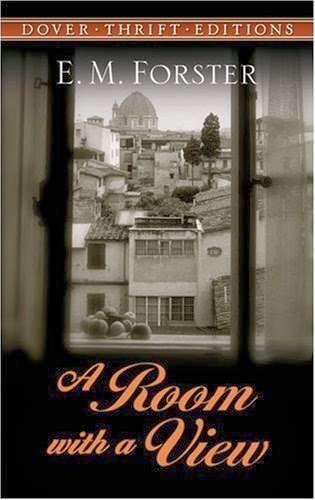
Review of 'A Room with a View'


I mentioned a couple posts ago that I had read A Room with a View. So now here is my review of it. I hope y'all enjoy. :)

A Room with a View is a well known book, I believe it is even considered a classic.... and for good reason. I remember picking this book up last summer and stopping midway. I can't imagine why.

I saw it at the library and decided to give it a go. I am happy I did. What I thought would be a short, nice little romance turned out to be much more than that.

Along with the romance came a little satirical critique on society. Lucy Honeychurch is a young lady on a tour around Europe with her guardian, her older cousin. I found Charlotte Bartlett to be extremely bothersome. "Whatever you want Lucy..... I am indebted to your mother for sending me on this trip.... I know my company must be dull for a young girl....." Ugh. Very fake and pitiable.

I could greatly sympathize with Lucy. It is difficult to feel one thing and have to do another. To do as expected instead of what one wants. To worry always how it will seem to other people; what they think, want, do.....
And to be young enough you speak freely when in "society" it simply isn't done.

Along with Lucy I wondered over George's intentions. He is unusual and crude, but I thought he would not be a cad, as Charlotte tried to make him seem. And I was quite justified, for though he is rather odd, he turned out rather well.

I believe the minister Mr. Beebe was very wise without knowing it when he talked of  Lucy living her life with as much gusto as she plays the piano. For piano is what made her happiest and that is how she ultimately ended up living her life.

I felt rather upset with Lucy near the end of the book when she tries to run from all her problems and to lie to everyone, even herself, about her true feelings. Luckily Mr. Emerson sets her straight. Mr. Emerson says what he is thinking, and though I certainly didn't agree with all he said, I found it refreshing.

Eleanor Lavish was as awful as Charlotte but in a different way. She tried to be too different, too against society. She was not real.  She seemed very fake and shallow. That is why even though she and Charlotte are very different, they end up being friends. They are both molded by "society" and not very relatable. (Autocorrect is saying that is spelled wrong... but it gives no good suggestion... hmm, oh well.)

Cecil, Lucy's fiance, was a bore. He was fine, but nothing special, nothing real. With George on the scene, he was sad in comparison. He was boorish. He thought he was much better than Lucy. He thought of Lucy as a work of art. The women must be protected at all times. (from what?) 'Lucy must find me immensely fascinating... why don't I drone on and insult everyone and everything in my fiancee's "country" village?"

Ick.

I liked her brother Freddy. He was jolly and was still young and uncouth enough to say what he thought as well. Mrs. Honeychurch was nice, but a little timid, a little too full of society. She loved Lucy and Freddy though so it was quite alright. I was disappointed that she and Freddy were so horrified at Lucy's latter choice of fiance. It is not that surprising, she did not "run off'"  with him, and they were respectably married. Ah well, I'm sure they will come to grips with it later.

Many things in the book made me think. Though it was a critique of early 1900s society, many of Forster's ideas struck me as true today. While I do not think we should all go as far as Mr. Emerson, maybe we should worry less about what society will think of us and more about what we think of ourselves. Do not be tied down to rules that do not seem right. Do the right thing, but not for the wrong reasons. These are some of the things I came up with as I was reading A Room with a View. I think it would be interesting if we all lived this way (myself included.)

Have you read A Room with a View? If so, what did you think of it? Were Lucy and George right? What are your thoughts on Forster's critiques of society?

Wednesday, February 5, 2014

A Review of Mrs. Miniver


Some correspondents of mine recommended the book Mrs. Miniver to me a while back. It proved a bit difficult to find, but finally my library had it at their main branch and had it sent over to me. (I just love libraries, don't you?)

So, I wasn't sure what to expect, because though I had seen the movie, I had been told the book was really nothing like it. This book is not even necessarily a novel. Rather, it is a bunch of short stories on a woman's life in around a year or so, I would say.

Each chapter was a separate story in and of itself, and I could read the chapters out of order and not be a bit confused. This is because the chapters were originally written as a column in The Times.

Mrs. Miniver, a book by Jan Struther, is about an upper middle class housewife pre-WWII and during the early years of WWII. It is about her thoughts, doings, and family. Mrs. Miniver is a unique person in her thoughts, and has a gift of making the everyday something special.

Sadly, as I was reading I didn't mark the things that stood out to me. So I shall just try to find them now, but I am sure some of the best snippets shall just slip past me.

"Mrs. Miniver was a fool about inanimate objects... It wasn't, with her, a question of the pathetic fallacy. She did not pretend to herself that cars had souls or even minds (though anybody, seeing the difference that can exist between one mass-produced car and another, might be excused for believing that they at least have at least some embryonic form of temperament). No, it was simply a matter of mise en scene. A car, nowadays, was such an integral part of one's life, provided the aural and visual accompaniment to so many of one's thoughts, feelings, conversations, decisions, that it had acquired at least the status of one's house. To part from it, whatever its faults, was to lose a familiar piece of background."

"Words were the only a net to catch a mood, the only sure weapon against oblivion."

"Not that he disliked school; but it had to be regarded, he found, as another life, to be approached only by way of the Styx, You died on the station platform, were reborn, not without pangs, in the train, and emerged at the other end a different person, with a different language, a different outlook, and a different scale of values. That was what the stray grown-ups you met on the holidays did not seem to understand when they asked you the fatuous and invariable question, 'How do you like school?' It was impossible to answer this properly, because the person of whom they asked it never, strictly speaking, arrived at school at all."

"She wondered why it had never occurred to her before that you cannot successfully navigate the future unless you keep always framed beside it a small clear image of the past."

And when getting gas masks with the children, the chapter ends so: "You did look a fright,' she said. "I 'ad to laugh.' One had to laugh."

I found the whole At the Dentist's chapter interesting.

I loved Aunt Hetty. "'Come along-we're having tea in the strawberry bed.' 'In the strawberry bed?' 'Yes. it's  a new idea that occurred to me last time Vin was here. You know how much better they always taste when you eat them straight off the plants? Only the drawback is, there's never any cream or sugar. So I thought, why not take the cream and sugar under the nets with us? We tried it, and it's a capital plan. I can't imagine why I never thought of it before.'"

I liked Mrs. Miniver's description of her first airplane flight in the chapter The New Dimension.

Her description of traveling struck me: "For you cannot make them understand the essential point, which is that when you went away you took the centre of the universe with you, so that the whole thing went on revolving, just as usual, round your own head."

"And it oughtn't to need a war to make us talk to each other in buses, and live simply, eat sparingly, and recover the use of our legs, and get up early enough to see the sun rise. However, it has needed one: which is about the severest criticism our civilization could have."

I also was amused when Mrs. Miniver spent her commute trying to find out what sound the new car's windshield wiper makes (beef tea), her agonies over which new calendar to get, and her musings over the strangeness of people who do not wait to catch a door someone else has already pushed open (Chapter: Christmas Shopping). I also enjoyed Three Stockings, and her musings on the way her children empty their stockings.

 Mrs. Miniver is a dear, lovely woman, and I loved her little book full of odds and ends and random thoughts. I wouldn't recommend it for everyone, but if you don't mind a book that is more about characters than plot, and more about everyday life than a sweeping tale of daring-do, then I recommend this to you.


Until next time then, lovely blog readers! Are you staying warm? It is freezing where I am, and I spent more than an hour today shoveling up inches and inches of snow and ice from the driveway.... brr! I think it is a tea and reading day!


Monday, January 13, 2014

Book Reviews


So, I have read and finished several books, and read and not finished several more. I thought I would just heap them all into one review and see what happens. Ready? Okay.


Wives and Daughters by Elizabeth Gaskell: Wives and Daughters is a classic novel that sounded right up my alley. And I loved the BBC version of it. (You can see the review here.) I started this book and get along very well. It is rather long, but I was already on chapter 17 and it had only been a couple of days! But then school started and I found myself not really reading that anymore. It was not because it was bad, in fact, I remember thinking that this was a lovely story and I loved when Molly was at the Miss Browning's. I have lately gotten into the bad habit of just letting books go. But I hope to pick it up again one of these days. I wish I had not watched the mini series first, as now I am rather impatient for Certain Proposals. (If that is even included in the work, as I know Gaskell died before the completion of this novel. Most unsatisfying, I know.)


Forty Acres and No Mule by Janice Holt Giles: This was one of my grandma's favorite authors, so I thought I would give her a try. It turned out that I had picked her autobiography of her beginnings at her and her husband's farm in the Kentucky mountains. I was a little worried, but it was not dull and factual, so I proceeded on my way. It was unlike anything I have ever read. The village is behind the times, even for just after WWII. They were a biblical society, living by God's rules, and not so much a governments. Most of them were hardworking farmers without electricity or even indoor plumbing! (that is where I draw the line) Yet Jan and her husband Henry were not happy with city life and so decided to move back to Henry's boyhood hometown. And after a little adjusting they had a marvelous time. It stressed simplicity, hard work, and yet calm. Jan seemed very happy and by the end said she wouldn't want to live anywhere else. I think all of us could use some of this happy simplicity, but as a lifestyle? I, for one, wouldn't really want to take that challenge.... I will count this as a finished read, because I read it word for word diligently and by the last 50 pages skimmed and scanned so I could get the happily ever after and on to a new book I was eyeing....


The Princess and the Sage by Anneliese Blakeney: I found Anne-girl's blog a couple of months ago, and enjoyed reading about her literary pursuits. Then I found that a delightful Lewis Carol-ish story that she'd been posting snippets of was actually out for people to buy! So I hurried to Amazon and ordered myself one. It is a quick and light read, but very funny and nonsensical. It is the author's first novel to be published and I enjoyed it muchly. 

I reread At Home in Mitford by Jan Karon before my mom came home with a stack of library books that I shall read after exam week. (Although they are so tempting. This reminds me that scene in Anne of Green Gables when Anne is studying the dreaded geometry so Gilbert doesn't get ahead, and she tells Matthew he should lock up that "thrilling" book her school chum gave her until she is finished studying, as it is such a temptation! I should do that...)

I may post reviews of the library books later, but for now I am ending this post, as that is all I have read thus far, and I have some science to study....

           .